Hybrid Catalysis B.V. was founded in 2005 to offer cost effective and highly competitive catalysis R&D. Now, we run a state of the art laboratory located in Eindhoven, The Netherlands. Hybrid Catalysis is capable of making, optimizing, and testing virtually any catalyst, ligand, or compound. Sophisticated custom-built process skids and a kilolab are available.
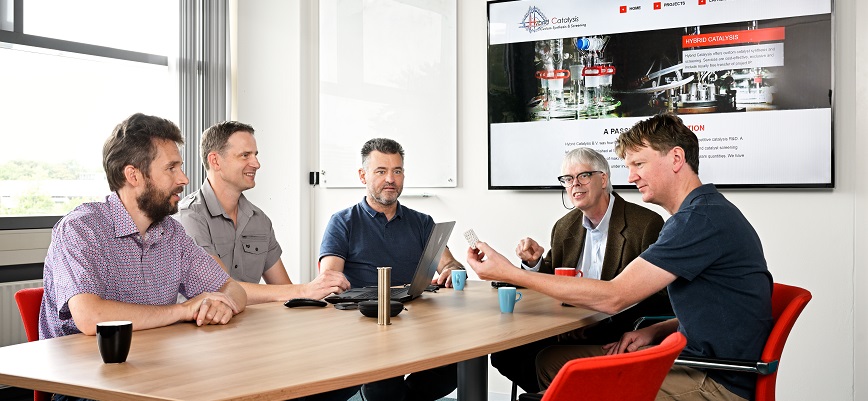
Gijsbert Gerritsen, Jos Wilting and Arjan Koekkoek are Hybrids senior scientists. Their joint expertise covers almost any topic and technique in catalysis. Professor Emiel Hensen, scientific advisor, is a specialist in heterogeneous catalysis with a deep understanding of catalytic phenomena, both at molecular and at industrial level. Managing director Erik Abbenhuis is author on many scientific publications, next to inventor on over 30 patents. Abbenhuis, a former associate professor at TU Eindhoven, founded Hybrid Catalysis in order to follow his passion for invention.
Please consider us as an extension of your own research organization. We offer contract R&D at fixed rates. All our quotations list clear deliverables and lead times. Every project proposal contains the elements you need to manage progress and budget. At the bench, your project is carried out by a motivated, PhD-level team with experiences including synthetic chemistry, high-throughput screening, chemical engineering, flow chemistry, catalyst shaping, informatics, scale up, and construction of custom setups. We really know about catalysis and meaningful research.
All projects are handled strictly confidential starting at inquiry level. Wherever we can, we work on an exclusive basis. This means that all IP generated belongs to the customer, free of royalties. In general, projects involve periods of a few weeks to six months. For the larger projects, we, ourselves, invest in equipment when needed.
Our laboratory is equipped for working with chemicals, gases, and pressure reactors. We can make changes to our infrastructure when required and have a network of subcontracted experts. Where required, they provide services such as: glass blowing, pipe fitting, metal machining, (electronic) assembling and custom software development. Being a small company enables us to act very fast.



Industrial processes are responsible for a large share of energy use, CO₂ emissions, and raw material consumption. A major reason is the reliance on conventional heating technologies, which are inefficient, slow to respond, and difficult to electrify. They often heat large unused volumes and limit innovation in recycling and sustainable production. CircuTherm is a project that addresses these challenges by developing a fundamentally different thermal processing approach based on inductive heating.
CircuTherm focuses on highly efficient, localized heating, where up to 90% of electrical energy is converted directly into heat at the exact location where it is needed. This is made possible through the integration of magnetic iron oxide nanoparticles, advanced inductive heating equipment, and a flexible platform for site specific heat generation. The result is a fast, controllable, and fully electrifiable process that reduces energy losses, lowers CO₂ emissions, and enables new circular processing routes that are not feasible with traditional heating methods.
Demonstration cases
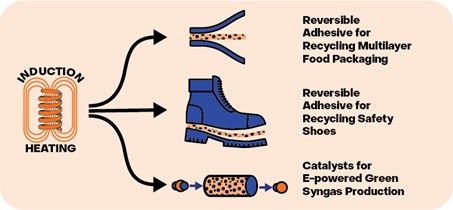
The CircuTherm technology is developed and validated in three industrial demonstration cases, where inductive heating and magnetic nanoparticles play a central role:
• Reversible adhesives for multilayer plastic packaging. Inductive heating is used to activate magnetic nanoparticles embedded in adhesive layers. This allows controlled debonding of multilayer packaging without damaging the individual layers, enabling high quality separation and improved recycling of plastics.
• Reversible adhesives in safety shoes. In footwear production, the technology enables selective heating of adhesive joints so that shoe components can be detached at end of life. This makes it possible to separate and recycle different materials, supporting circular product design.
• Inductively heated catalysts for CO₂ conversion. Magnetic nanoparticles are integrated into catalytic materials, allowing direct inductive heating of the catalyst inside a reactor. This enables efficient and electrically driven operation of energy intensive reactions such as the reverse water gas shift (rWGS), improving process efficiency and reducing reliance on fossil based heating.
Towards industrial impact
CircuTherm will demonstrate these applications at pilot scale and assess their environmental and economic performance using life cycle assessment (LCA) and techno economic analysis. By combining energy efficiency, electrification, and circular design, CircuTherm supports the transition toward low carbon, future proof industrial processes across multiple sectors.